Micro-optics
Micro Prism Micro Lens Micro Window Rod Lens Micro Lens ArrayOptical Spherical Lens
Plano Concave Lens Plano Convex L Lens Achromatic Cemented Lens Meniscus Lens Double Concave Lens Double Convex Lens Half Ball Lens Custom Hyper Hemisphere LensOptical Dome
Visible Optical Glass Dome Ultraviolet (UV) Dome Infrared (IR) Dome Dome With FlangeOptical Prism
Optical Wedge Window Corner Cube Retroreflector Roof Prism Pyramid Optical Octagon Light Guide Rod Penta Prism Light Guide Prism Dove Prism Cube Beamsplitter Anamorphic Prism Powell Prism 30° - 60° - 90° Littrow Dispersion PrismsCylindrical Mirror
Plano Concave Cylindrical Lens Plano Convex Cylindrical Lens Achromatic Cemented Cylindrical Lens Round Cylinder Meniscus Cylindrical LensFilter
Dichroic Filter Bandpass Filter Longpass Filter Neutral Density Filter Narrow Bandpass Filter Cut Off Filter Mosaic Filter Band Pass Linear Variable Filter Cut-off Linear Variable Filter Pixel Level (Stepped) Hyperspectral FilterOptical Window
Brewster Windows Parallel Windows Witness SamplesCNC Light Weight Component
Silicon Material Silicon Carbide Fused Silica Zerodur MacorAspherical Lens
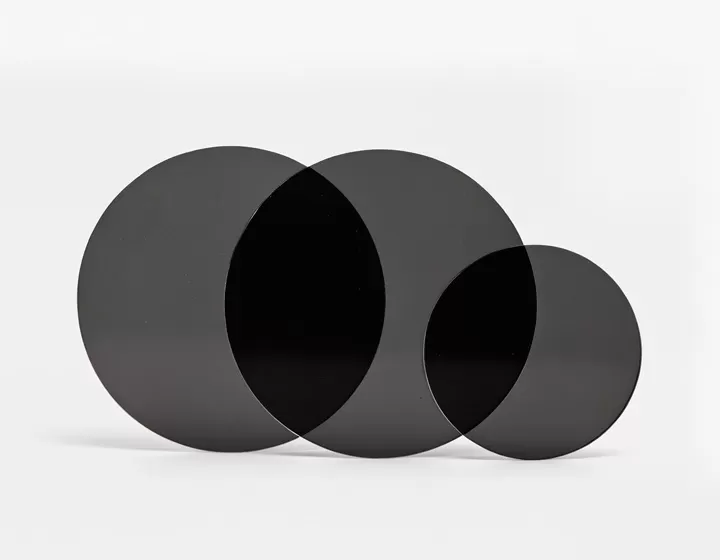
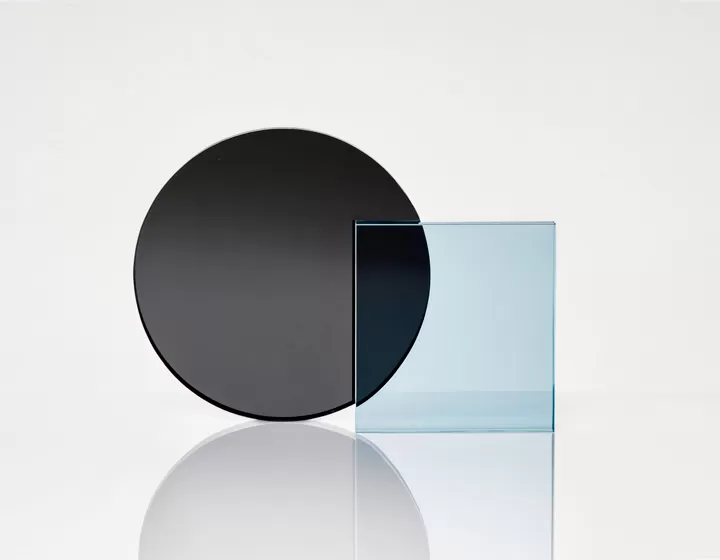
Transmissive Aspherical Lens Reflective Aspherical LensThis is a very unique and practical optical component, whose core function is to uniformly reduce the intensity of all wavelengths (colors) of light without changing the spectral composition and color balance of the light source.
ECOPTIK makes fixed OD value neutral density filter by depositing Inconel film on a clear cubstrate. The advantage of the optical density filter is in the broader band and lower ripple than that of absorptive density filter. The coated wavelengthcan be extended to 200nm to 1100nm or more. The disadvantage is that there is some reflective light on the optical filter glass. The OD value can vary from 0.1 to 0.5. The OD value is controlled by coating inconel thin film thickness. Regular thickn thickness of the NDF is 1.1mm or 0.55mm.
This kind of optical density filters can be used for video, waterfalls, ophthalmology and landscape photography.
Material | BK7 |
Diameter tolerance | +0.0/-0.1mm |
Thickness tolerance | ±0.1mm |
Parallelism | <3 arc min |
Flatness | λ~λ/10 |
Clear aperture | >90% |
Density tolerance | ±2% |
Part No. Wanvelength Range(nm) Optical Density (OD)@550nm | ND01 400-1100 0.1 ND02 400-1100 0.2 ND03 400-1100 0.3 ND04 400-1100 0.4 ND05 400-1100 0.5 ND06 400-1100 0.6 ND07 400-1100 0.7 ND08 400-1100 0.8 ND09 400-1100 0.9 ND10 400-1100 1 ND20 400-1100 2 ND30 400-1100 3 ND40 400-1100 4 ND50 400-1100 5 |
1. Absorption type ND filter
Working principle: Made of glass or optical plastic containing uniformly suspended carbon particles or metal particles. These particles uniformly reduce light intensity by absorbing light energy and converting it into thermal energy.
Features:
Advantages: Low cost, insensitive to incident angle, and less prone to stray light.
Disadvantages: Under high-power laser, it may rupture or produce thermal lens effect due to heat absorption, and its neutrality may not be as good as that of reflective type.
2. Reflective ND filter
Working principle: Coat a metal film with neutral reflective properties (such as chromium, nickel chromium alloy, inconel) on a glass substrate. Reduce light by reflecting (rather than absorbing) a portion of the light.
Features:
Advantages: It usually has better neutrality, high temperature resistance, and high power.
Disadvantages: High cost, reflected light may form ghosting or stray light, affecting system performance.
3. Reflection/absorption hybrid type
Combining the advantages of both, it is commonly used in high-end photography ND mirrors to minimize ghosting caused by reflection while ensuring neutrality.
4. Variable ND filter
Working principle: Composed of two linear polarizing plates. When a polarizing film is rotated, the angle between its polarization direction and the other film changes, thereby continuously changing the transmittance.
Features:
Advantages: One filter covers multiple OD values, which is very convenient.
Disadvantage: It is not truly "neutral" and is sensitive to polarized light, which may result in uneven sky color or "cross shaped" dark corners. The imaging quality is usually inferior to fixed ND mirrors.
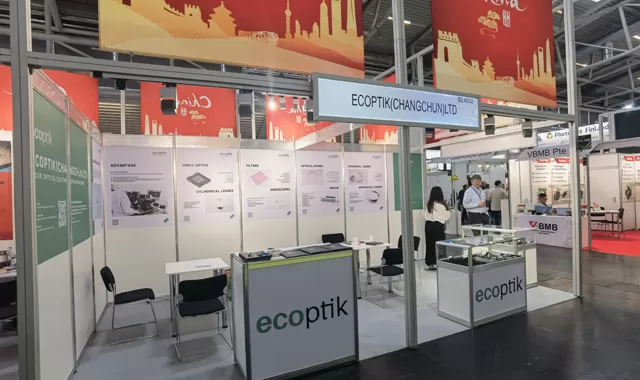
More Place to Find ECOPTIK
30
2025.10
30
2025.10
25
2025.06